From Number Cruncher to Strategic Advisor: How AI is Revolutionizing the Accountant's Life
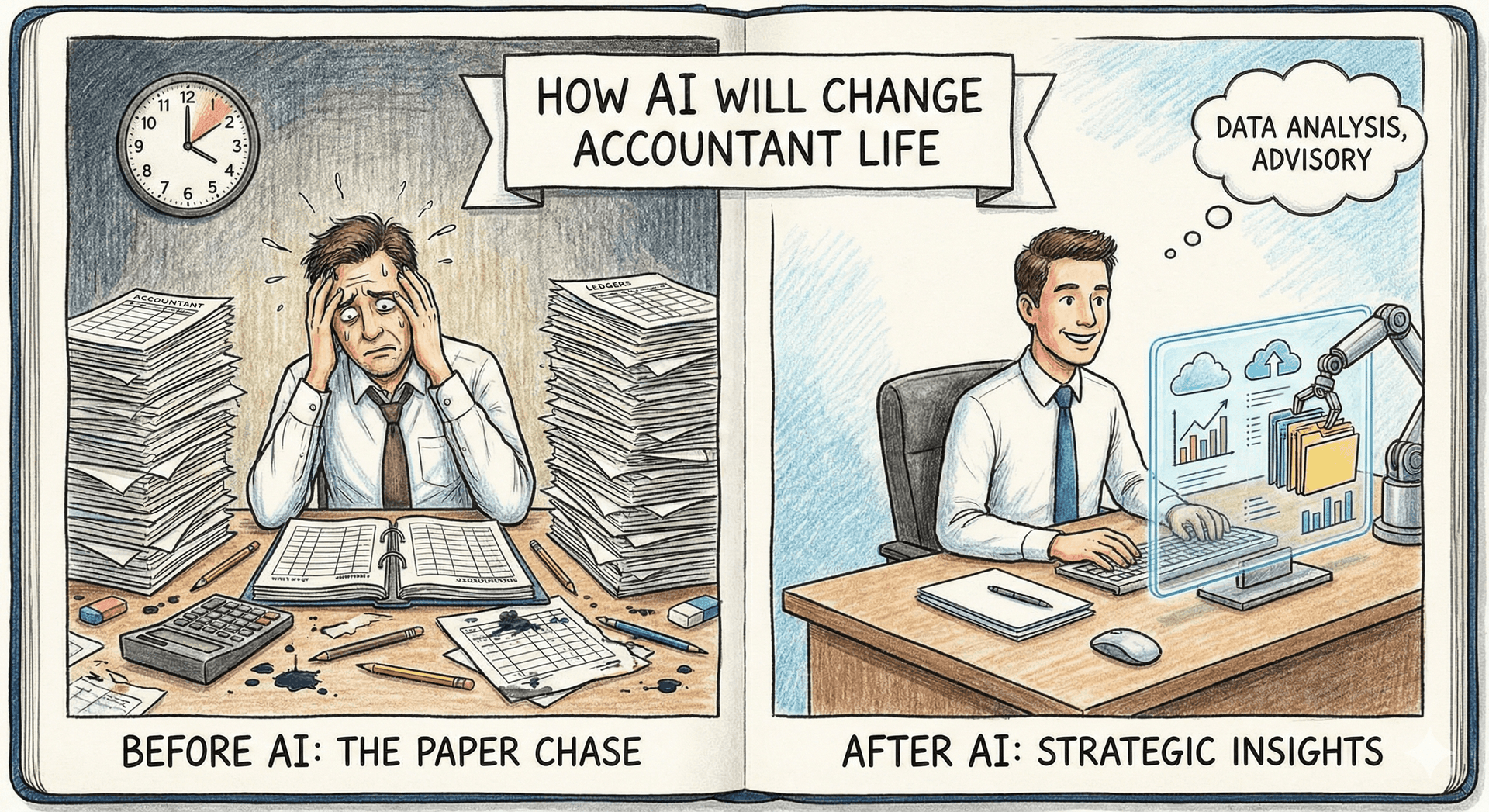
The stereotypical image of an accountant is deeply ingrained in popular culture: a stressed professional hunched over a desk, surrounded by towering stacks of paper ledgers, working late into the night with only a calculator for company.
For decades, this "paper chase" was the reality. The bulk of an accountant's life was spent on retrospective work—recording history, balancing books, and manually reconciling endless transactions.
But a seismic shift is underway. Artificial Intelligence (AI) is no longer a futuristic concept; it is actively reshaping the accounting landscape. Far from the dystopian fear of robots stealing jobs, AI is proving to be the ultimate tool for liberation, freeing accountants from mundane drudgery and elevating them into high-value strategic advisors.
Here is how the AI world is fundamentally changing the life of the modern accountant.
1. The End of the "Paper Chase": Automating the Mundane
The most immediate impact of AI in accounting is the automation of repetitive, low-value tasks. This is the shift from the "stressed" side of the image to the "efficient" side.
Traditional bookkeeping often involves manual data entry from invoices, chasing clients for receipts, and hours spent figuring out why the bank statement doesn't match the ledger by a few cents.
How AI changes this: Machine learning algorithms can now scan invoices, recognize vendor information, categorize expenses automatically, and reconcile bank feeds in real-time. What used to take days during "month-end close" can now be done continuously throughout the month with minimal human intervention.
- The Result: Accountants are reclaiming thousands of hours previously lost to manual data processing. The focus shifts from "getting the data in" to ensuring the data is accurate.
2. The Rise of the Real-Time Strategic Advisor
Historically, accounting was reactive. Financial statements told business owners what happened last month or last quarter. While useful for compliance, this historical data often came too late to make agile business decisions.
AI flips this model from reactive to proactive.
How AI changes this: Because AI can process vast amounts of data instantly, it provides real-time financial visibility. Instead of waiting until the 15th of the next month to see how the business performed, an accountant using AI tools can see a live dashboard of cash flow right now.
More importantly, AI is predictive. It can analyze historical trends to forecast future cash flow issues, identify potential credit risks before they happen, or suggest optimal pricing strategies based on market data.
- The Result: The accountant's life changes from being a historian to being a navigator. They use AI-generated insights to guide clients toward growth and away from risk.
3. Shifting Skills: From Calculation to Interpretation
As AI takes over the "heavy lifting" of calculation and categorization, the core competency of a successful accountant is changing rapidly.
The ability to manually calculate a complex depreciation schedule is becoming less valuable than the ability to interpret what that depreciation means for the company’s long-term capital investment strategy.
The new essential skills for accountants include:
- Data Analysis & Interpretation: Understanding what the AI-generated charts and graphs actually mean for the business.
- Tech-Savviness: Knowing which AI tools to implement and how to manage them.
- Communication & Empathy: AI can provide the data, but it cannot communicate the implications to a worried business owner with empathy and clarity. The "human touch" becomes more valuable, not less.
4. Why AI Will Not Replace the Human Accountant
The most common fear is that AI will make human accountants obsolete. This is highly unlikely. AI is a powerful engine, but it lacks a steering wheel.
AI is brilliant at processing structured data (numbers and categories). It is terrible at nuance, ethics, professional judgment, and complex relationship management.
An AI can tell a business owner that their payroll costs are 12% higher than industry averages. It cannot understand the nuance that the business owner is paying extra to retain loyal staff during a labor shortage, nor can it advise on the ethical implications of a complex tax loophole.
The role isn't disappearing; it is evolving up the value chain. The accountants who will struggle are those who insist on only doing the manual work that machines can now do better.
Conclusion: A Better Quality of Life
Ultimately, the integration of AI into the accounting world is leading to a better quality of life for the professionals within it.
By removing the high-stress, repetitive grunt work that leads to burnout, AI allows accountants to focus on stimulating, analytical work that genuinely helps their clients succeed. The future accountant is less likely to be found buried in paper at midnight, and more likely to be found using sophisticated dashboards to present strategic growth plans to their clients.
The AI revolution in accounting is not something to fear—it is something to embrace.
Comments (0)
No comments yet — be the first to share your thoughts.